
Emily in Paris Stereotypes: True or False?
As an American living in Paris myself, Emily in Paris came out just around the time I was moving to France – and ever since then, I’ve enjoyed binge-watching the show, but also watching with a critical eye to see if the stereotypes Emily in Paris makes about the French and expat life are true or false.
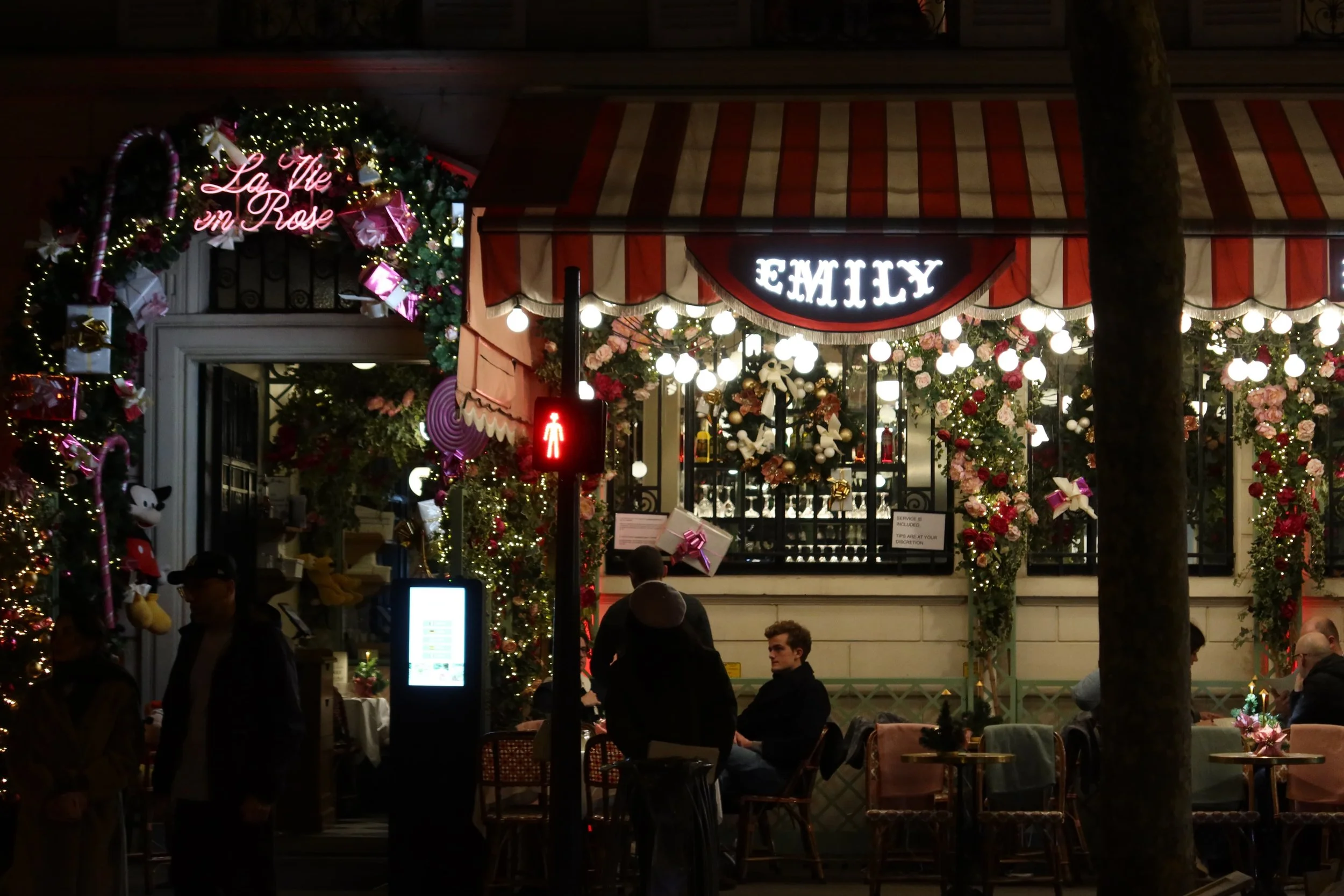
View of Emily in Paris themed café near Eiffel Tower; at night December 2025
As Emily in Paris has just returned for its fifth season on Netflix on Thursday, December 18th – I’ve recently re-watched the show (again) to pay close attention to the various stereotypes made in Emily in Paris to finally confirm their truth once and for all or finally put them to bed.
General Stereotypes in Emily in Paris
🇫🇷✨ “Emily in Paris” — What It Got Right vs. Wrong 🎬
📄 Work permit paperwork headache
The stack of paperwork Sylvie waves around for Emily’s work permit is very real — admin in France is intense. The show implies Sylvie applies for the visa herself, when in reality that would be Emily’s job, but the general bureaucracy vibe is accurate and much closer to reality than in many other shows.
💬 Comments about needing a French partner
The comments Emily gets about needing a French boyfriend or husband are, sadly, spot-on. Even after years of living here and “making it” on my own, I still hear remarks about how I’ll never fully integrate or speak perfectly without a French partner.
🇫🇷 Learning French is slow and hard
People tease Emily for not speaking French yet, but in the show’s timeline she’s only been in France a few months. I wasn’t speaking decent French until after two years — it really does take time to learn the language and feel part of French society, especially if you’re as American-coded as Emily is.
👀 “Doing nothing” as an art form
In season 1, Mindy says that in Paris “nobody judges you for doing nothing — it’s practically an art form,” and that’s very true. So much of Parisian life is about lingering in cafés or parks and simply people-watching.
🚬 Smoking inside all the time
The show makes it seem like everyone smokes indoors, which is completely false. In Paris — and across France — people step outside or sit on the terrace to smoke.
❤️ Affairs everywhere
Affairs are played up as a French cliché, but that’s not everyday reality. Most French people I know prefer serious relationships and aren’t constantly juggling dramatic affairs the way the show suggests.
👗 Emily & Mindy’s over-the-top outfits
Their loud, colorful outfits would make them stand out instantly in Paris. Most women here wear neutral tones and simple, classic “chic” pieces — Sylvie’s wardrobe is far closer to how Parisians actually dress.
🤝 “French don’t do handshakes”
Mindy says the French only do la bise, not handshakes. While cheek-kissing is common socially, I’ve still shaken hands in professional settings and it’s never been an issue — both greetings coexist in real life.
Emily in Paris Stereotypes: True or False?
I’m going to break down as many of the stereotypes in Emily in Paris about both French people and immigrant life in France as I can by each season of the show:
Season 1
Episode 1: “Emily in Paris”
Colleague Doesn’t Speak English
In the first episode, Emily starts to lead a meeting with her new team – speaking loudly like an American (I can confirm this is true, after having living abroad – Americans do speak a little too loud).
However, the stereotype they put in the show – is when one of the colleague’s ups and leaves because she refuses to speak any English. While this can be true, even in Paris – it generally isn’t true with people younger than 40.
Therefore, I found it a bit odd to put in the show – it would have made more sense to have Emily be in a restaurant or a grocery store with an older man or woman (kind of like when she goes to the bakery near her apartment in the early episodes) who only speaks to her in French because they truly don’t speak any English.
True or False?: False
Emily’s Apartment Size
Anyone in Paris is going to tell you the same thing: Emily’s apartment is simply way too big and unrealistic for her to be renting given the real-life salary she typically would make at her job. However, that being said – as she was technically working for her U.S. firm “The Gilbert Group” in Chicago while abroad, the show did insinuate that her company was paying for it from the United States. This can happen – as I have had American friends in Paris in the same situation
True or False?: Depends; generally false
Want to see what a real Parisian apartment in an expensive neighborhood like Emily’s usually looks like? Check out my apartment tour video below!
Episode 2: “Masculin Féminin”
Finding a French Boyfriend
In this episode, Antoine makes a comment to Emily about needing to find a French boyfriend – and how her current boyfriend back in Chicago won’t help her with her French.
“Well then, you need to find yourself a nice French boyfriend.”
As much as I hate to say it, this stereotype is absolutely true. As an American living in Paris for years, I’ve had people both in the workplace and at social gatherings press me about why I haven’t found a French partner. They try to soften it, the exact same way Antoine did in the show, by bringing up women too in the event you’re not straight – but it doesn’t change the overall motif of what they’re inferring: that you are nothing without a partner.
True or False?: True

View of Eiffel Tower at night on bateaux mouches; September 2025
Affair with Sylvie
In the same episode, we are introduced to the concept of Sylvie having an affair with Antoine – who has been married for presumably a couple of decades. From my experience getting to know French people, especially around Sylvie and Antoine’s age – I find this “affair” French stereotype in Emily in Paris to completely false.
Many French people I know prefer to be en couple or married in a serious relationship, not having flings and certainly not having an affair.
True or False?: False
Episode 3: “Sexy or Sexist”
People Peeing on the Seine
On Emily’s run early in this episode, while on the phone with a pregnant Madeline, she notices a man peeing in a urinal behind her.
In my over 4 years of living in France, I have never seen a man on seine ever – most people would just opt to go into a café alongside the seine or walk up to use one of the public toilets.
Parisians have a lot of pride in class, so I would say this was more for humor in the show and not a real depiction of everyday life – especially not in the neighborhood where she was running.
True or False?: False

View of Paris seine at sunrise; July 2021
Shower Not Working and “Impossible” to Fix
This is another component in Emily in Paris that is absolutely accurate.
The scene where Emily’s shower is broken, and Gabriel helps her with the repair man who only speaks French – is so true to real-life in France it hurts. You see, everything in France is a “no” until you turn it into a “yes” – and this scene exactly depicts that.
I have had repair men come to my apartment to fix something without any tools. I’ve even had them use my tools from Leroy Merlin, which cost me around €25, and then charge me €400 for the repair.
I’ve also had two young men come to my apartment in the middle of the night to fix it, and then claim they didn’t have the right part – and then return to their van downstairs, and find the part, only to charge me €1400 to fix it.
It’s more than true that a lot of repairs in France are slow, but the show didn’t demonstrate just how expensive home renovations or even small repairs such as a leaky faucet or damaged pipe can cost.
True or False?: True
Episode 4: “A Kiss Is Just a Kiss”
Paris Being a “Big Town” Over a “Small City”
This is the episode where Emily and viewers alike are introduced to Camille, when she helps Emily to buy the pink flowers from the South of France she wants.
They get to chatting, and Camille mentions how Paris is more like a small town than it is a big city – and this is incredibly true.
“Relax… Paris seems like, a big city – but it’s really just a small town.” – Camille to Emily walking back to their apartment after meeting for the first time.
This is one of the most accurate things to have ever been said on Emily in Paris. I cannot tell you how many times I have been on the other side of the city, and run into someone that I know while walking along a major street.
I’ve also ending up going to clubs or meet-ups where someone I knew ended up being there. A colleague at work ended up being one of my friend’s partner’s best friends from childhood.
Paris really is more of small, cozy town than a big, bustling city. This is one of the many ways in which Paris differs from other big cities, such as New York City.
True or False?: True
Packages Delivered Directly to Your Door
This is one of those scenes in Emily in Paris, that as an American actually living in Paris, makes me cringe… because it couldn’t be further from the truth.
As an American, I grew up with the privilege of packages being delivered to my doorstep – often being left in the garage, mailbox, or on the porch… but France, and the rest of Europe according to my European friends, isn’t quite like that.
Even living in central Paris, if I want a package delivered to my door – I need to leave the ringer on my phone, LOUD, for when the delivery man calls. If I don’t answer it or call him back within one minute of their call – the delivery man leaves, thinking I am not home, and will leave the package at a point relais.
This is truly a foreign concept for Americans, but a point relais, (loosely translating to “pick up point”) often located in a gift shop or convenience store – is a place where locals can go to pick up their packages, as most people aren’t home or can’t stare at their phone 24/7 to answer the deliver man’s call.
The only exception to this, is if like Emily – you have what’s called a gardien or gardienne in your apartment building, or someone who is there in the building to always answer the door when someone arrives.
However, even the friends I have in Paris who do have a gardien have told me that they often default to having their items delivered to a point relais as it’s usually the more “reliable” way to receive your package in France.
As a whole, and I cannot stress this enough – packages are never, EVER delivered to your door in France. Even if it makes it to the building, you usually have to walk down to get your package and bring it back up – and many of us in Paris live in old buildings without elevators!
True or False?: Somewhat true, but usually unlikely

View of Paris from the Pathéon; June 2024
Episode 10: “Cancel Couture”
Getting Fired in France
In this episode, Sylvie “fires” Emily and tells her to pack her things and never show her face in the office again.
In my earlier days living in France, I used to agree with this scene in the show – until I had my own CDI (permanent job contract, similar to what we can surmise Emily and her colleagues have in the show) and was let go of from the company.
“No, it’s impossible to fire someone in France.”
To preface this explanation, it is true that in France – employees generally have stronger working rights than in the United States. I used to laugh at Luc’s advice to Emily to just “wait it out” until they forgot about filing the paperwork.

View of Paris with Musée d’Orsay; November 2025
Luc and Julein did get one thing right: any government or bureaucratic process in France can indeed take months – including the process of trying to fire someone in France.
“My friend got fired from a law firm. He was so angry that he threw his phone into the seine. They couldn’t reach him for weeks to complete his termination… and then, they relaxed! He’s a partner now!”
However, I have since learned that while it is true that a “formal dismissal” or liscenment in France (like what Emily was potentially facing) can take months to move forward –there are other ways that you can be let go of from a job in France and it take a less amount of time.
The overview cards below will reveal some of the ways you can be “fired” in France – both of which do not take effect immediately and still take time, as Luc implied.
🇫🇷📄 How You Can Be “Fired” in France — Explained
🤝 Rupture conventionelle
The most popular and “nice” way to amicably leave a company in France. The closely American equivalent is a “buyout” – but it still isn’t a direct equivalent. In this case, either the employer or employee can “offer” this “deal” to one another, where a severance pay is paid out. Even then, you’ll have to stay at the company for a minimum of a few more weeks once everything is decided.
📉 Licenciement économique
The closest thing to being “laid off” in France. This is a version of “being fired for economic reasons” where a company admits it’s in financial trouble. In this case, employees often get up to one year of their salary – but as a result, many companies first try to get employees to partake in a rupture conventionelle as it costs them less time and money than licenciement economique.
🕒 Terminating contract before trial period
In France, on a CDI, companies have what’s called a “period d’essaye”, or a trial period, where at any time – either party can terminate the contract. In this case, you could be “fired” on the spot (like how Gabriel does with his pastry chef later in season 4) – but this was unlikely, as at this point in the show, Emily was still on a specific work-exchange program visa with her company in Chicago and likely didn’t have a French CDI with Sylvie at Savoir yet.
Overall, I too used to believe in the notion that you “can’t get fired in France” and that your job was bulletproof. It may be harder to get fired in France, but it’s certainly not as black-and-white as the show makes it seem.
Ultimately, you can get fired in France – it just takes more time and money for companies to proceed with the process as opposed to it taking effect immediately in the United States.
True or False?: A mix of both… it’s true, but it’s not true.
Season 2
Episode 2: “Do You Know the Way to St. Tropez?”
Working on the Weekends
While Emily is on a trip to St. Tropez, several of her colleagues (such as Luc and Sylvie) tell her that it is illegal to work in France on the weekend.
“Stop trying to fix everything! You’re just making more work for everyone else. On a weekend. Which is illegal.”
Yes, France does have more work-life balance than the United States – there’s no questioning that.
However, working on the weekend isn’t out of the question – it’s a personal preference where some gladly sign up to partake in projects that would require weekend work.
As a whole, this simply isn’t true, especially in companies that work with RTT time or young start-ups – where energy is high and people want to succeed.
True or False?: False
Episode 7: The Cook, the Thief, Her Ghost, and His Lover
No Air Conditioning in France
In this episode, there seems to be a massive heat wave going on around Paris – and Emily in particular is struggling to adapt to no air conditioner.
While this depends on the building you live or work in, it is mostly true yes – there is generally no air conditioning in France. This is because old apartments and Haussmann style buildings in Paris are not equipped for air conditioning, and their older designs result in poor insulation… making it feel hotter than it already is.
True or False?: True
Exercise in France
In this episode of Emily in Paris, we hear from Pelaton that exercise is not a lifestyle in France the way that it is in the United States.
“From what our research tells us, exercise more like a past time in France – not a lifestyle…”
While this is true as a whole, seeing as the ‘lifestyle” of planning your life outside of work around the gym or wearing workout clothes to pick up your kids simply doesn’t exist in France – exercise is far from obsolete in French culture.
In fact, many jobs in Paris will offer to pay a stipend for you to get discounts to locals gyms or workout classes – making this Emily in Paris stereotype more dependent on the area in Paris, France, and the age group.
True or False?: A mix of both; relatively true but not entirely accurate
Season 3
Episode 1: “I Have Two Lovers”
Eating on Top of the Eiffel Tower
There are only two restaurants at the top of the Eiffel Tower, but it’s true that Americans and other tourists love to eat up there – even though the whole neighborhood is overpriced.
True or False?: True

View of seine and Eiffel Tower at night; August 2024
Do The French Like McDonalds?
Yes, the French love to eat McDonalds – I’ve seen my very French neighbor (who is not Gen Z, by the way) have it delivered to his door before. In fact, I wouldn’t even call it a petit plaisir the way Gabriel did – but a pretty common pit stop or “easy meal” for couples in France.
“It’s what we call a petit plaisir.. a little treat, um… indulgence.”
Fun fact, French people call it Le DoMac!
True or False?: True
Episode 2: “What’s It All About…”
French Flattery
In this episode, Luc tries to educate Madeline on how to speak to someone French in order to get on their good side.
“And the French, love flattery. You have to talk French people in a certain way… they like to hear sweet things… bonjour, bonsoir, après vous, merci… all that, remember – French is the language of diplomacy.”
As someone who has lived in France for a while now, I have to say – this is very true. Although, I wouldn’t call it flattery as much as I would call it they enjoy formal and polite commentary prior to being helpful.
For instance, one time I was flying to New York City from Paris and the line was full of Americans. The French man checking everyone’s passports was very annoyed that no one told him to have a good day. When it was my turn, I said in French, “Merci monsieur, bonne journée” and he turned around and smiled, pointing in my direction.
It’s true that if you’re a “kiss up” to French people – they will be much more willing to be helpful or to even like you.
True or False?: True
Episode 4: “Live From Paris, It’s Emily Cooper”
Being Unemployed in France
In this episode, we see Emily exploring life without work… but in the show, they make it seem like Emily would be able to just stay in the city without the right paperwork.
The reality is, she wouldn’t necessarily get to stay in France unless her resident permit had yet to expire – but given in season 3, Madeline says she’s only been there a few months, it’s probable her year-long work exchange visa hasn’t run out yet.
True or False?: Not accurately depicted with details; mostly true

View of the Sacré-Cœur in Paris; September 2025
Tax Paperwork in France
There is no further explanation needed for this. All the tax paperwork… just… YES… it’s all true.
When I went to renew my current residence permit in France, I took 64 pages of printed paper with me to the appointment. No further explanation needed.
True or False?: True. Painfully, 100% true.
Ferris Wheel on Emily in Paris
As someone who has lived in Paris for years, this is the stereotype made on Emily in Paris that infuriates me the most – as it paints Paris as a city only about romance instead of what it actually is: a dirty, grimy, busy city.
In this episode, Luc and Julien make a comment to Emily about how everyone get intimate on the infamous Ferris Wheel– but this comment couldn’t be further from the truth.
Factually, Fête des Tulieries, which is around twice a year (during Christmas and then again during the summer )– is one of the most family friendly places in Paris. To be honest, every time I re-watch Emily in Paris and see this joke – it makes me angry. I understand it’s supposed to be a fun, sexy show – but this comment took it too far out of touch, for me.
True or False?: FALSE. I cannot stress how silly and inaccurate this one is…

View of the Ferris Wheel in Paris; June 2021
Episode 5: “Ooo La La Liste”
Work Permit or Visa Paperwork in France
In this episode, Sylvie is in the process of securing work visa paperwork for Emily. While it’s 100% true that Sylvie would need to prove how Emily is so exceptional that no French person can do job – it’s the work permit that Sylvie would apply for, not the actually visa (this would’ve been Emily’s job to go the préfecture with the work authorization and apply for the work visa herself.
Furthermore, Emily wouldn’t be legally allowed to work at all without the work permit – not even under the table at Gabriel’s restaurant, as it’s technically illegal – but many people do it.
Lastly, the jokes that the Australian woman makes to Emily about Gabriel being answer to work visa is unfortunately very true. As I mentioned earlier, people in France (men and women alike) often view me as making my life more difficult as it should be – and that if I married someone French, it would make my life easier.
True or False?: True; with some details not fleshed out (Sylvie would so the work permit, Emily would apply for the work visa herself at the prefecture)
Season 4
Episode 3: “Masquerade”
Is It True Dry January is Banned in France?
In this episode, while trying to market alchoal free beverages in France at Agene Grateau – Luc tells Emily that Dry January is banned in France.
While it’s not banned by President Macron, the French government has said that they don’t find it to be a sustainable way of life.
“Dry January is part of an all-or-nothing logic… this is a model unsuitable for the reality of French consumption. ”
However, Luc’s comment does make sense – as drinking is very social in France. From work parties to catch ups with friends – a lot of life in France revolves around all of life includes an aperitif.
True or False?: False; but the overall “theme” Emily in Paris was trying to convey is true
Want to see more of Paris besides where Emily’s been?
Click here to discover more, as I have several articles like this to help you plan the perfect trip to Paris and the rest of France.
Additional articles you may find helpful include:
Never want to miss out on my local Parisian tips? Be sure to sign up for my newsletter to always hear the latest on what’s going on in Paris.

Last updated: December 21, 2025